
The First Signs of Safe Superintelligence
Intelligence Compounds. Runtime Safety Holds.
Over the past two years, Project 777 has built and validated a new architecture: a compounding intelligence layer above frontier models. Across governed runs and materially different sectors, validated intelligence is retained and reused, the system improves its own memory, solutions, workflows, and architecture within fixed boundaries, runtime safety remains independent and active, and the same protected core carries accumulated intelligence from one sector to another without core redesign. Together, these three breakthroughs — runtime intelligence and safety, bounded recursive self-improvement, and cross-sector operation through the same core — are the first signs of safe superintelligence.
"
"Having worked on agentic AI at Meta Superintelligence Labs, I’ve seen where frontier AI systems are heading. After reviewing Project 777’s technology and evidence, I believe it is showing the first real operating signs of bounded, safe superintelligence — intelligence that improves and compounds while remaining under independent runtime control. That is why I chose to join Project 777 as Strategic Technical Lead."
Sean Perry
Former Agentic AI, Meta Superintelligence Labs
Strategic Technical Lead, Project 777
TECHNICAL LEADERSHIP
TK Stohlman
Founder & Architect
AI Founder | Prior AI Exit

Sean Perry
Strategic Technical Lead
Former Agentic AI, Meta Superintelligence Labs

Preston Dunlap
Technical Advisor
Former CTO & Chief Architect, U.S. Space Force & U.S. Air Force

Mike Rosol, PhD
Scientific & Medical Advisor
CEO, Atherion Bioresearch | Former CMO, Navidea
EXTERNAL VALIDATION

David Bray, PhD
Former FCC CIO
Government Technology & AI Systems
Roma Shusterman
CTO / Head of R&D
20+ Years in Safety-Critical & FDA-Cleared Systems

Ian Perez Ponce
CTO
Former AWS Technology Leader

Matthew Skinner, MD
Board-Certified Physician
Scripps Clinic
Project 777 is not another model company.
Project 777 is a model-agnostic compounding intelligence layer above frontier models and agents. Three things make the compounding intelligence layer possible, and they work together:- Runtime Intelligence and Safety Checks: Every output is reviewed while the run is still happening. The system checks whether it stayed on task, whether its claims are supported, whether its sources can be verified, whether it uses the right benchmark when one applies, and whether it follows the rules for that field. Work can pass, be blocked, be sent back for correction, or be held for further review before it moves forward.- Bounded Recursive Self-Improvement: The system improves its own memory, solutions, workflows, and architecture. But the part that proposes an improvement is never the part that approves it — a separate layer measures whether the change actually helped, and it's only kept if the evidence holds.- Cross-Domain Operation. The same protected core runs across materially different sectors and domains without being rebuilt for each one.
The Layer Above Frontier Models
If frontier models are the engines, Project 777 is the intelligence layer that coordinates how those engines operate, what their work must prove, what capability is retained, and how the system improves over time.The underlying model can be changed, combined, or upgraded while Project 777 preserves validated memory, evaluation, auditability, and accumulated intelligence.This creates a strategic asset above interchangeable models rather than tying value to any single model provider.
Project 777: Turning AI Reasoning Into Deployable Solutions
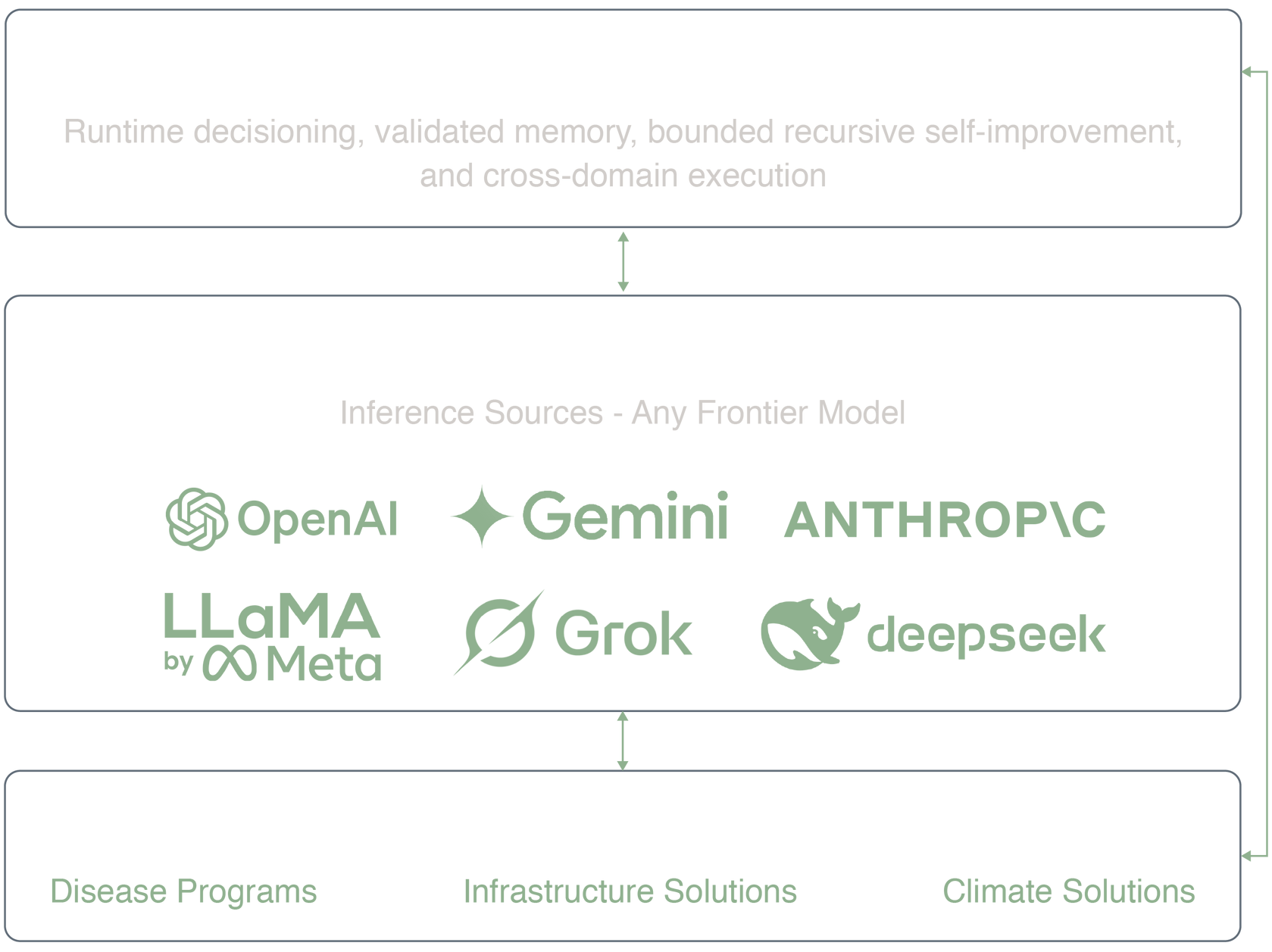
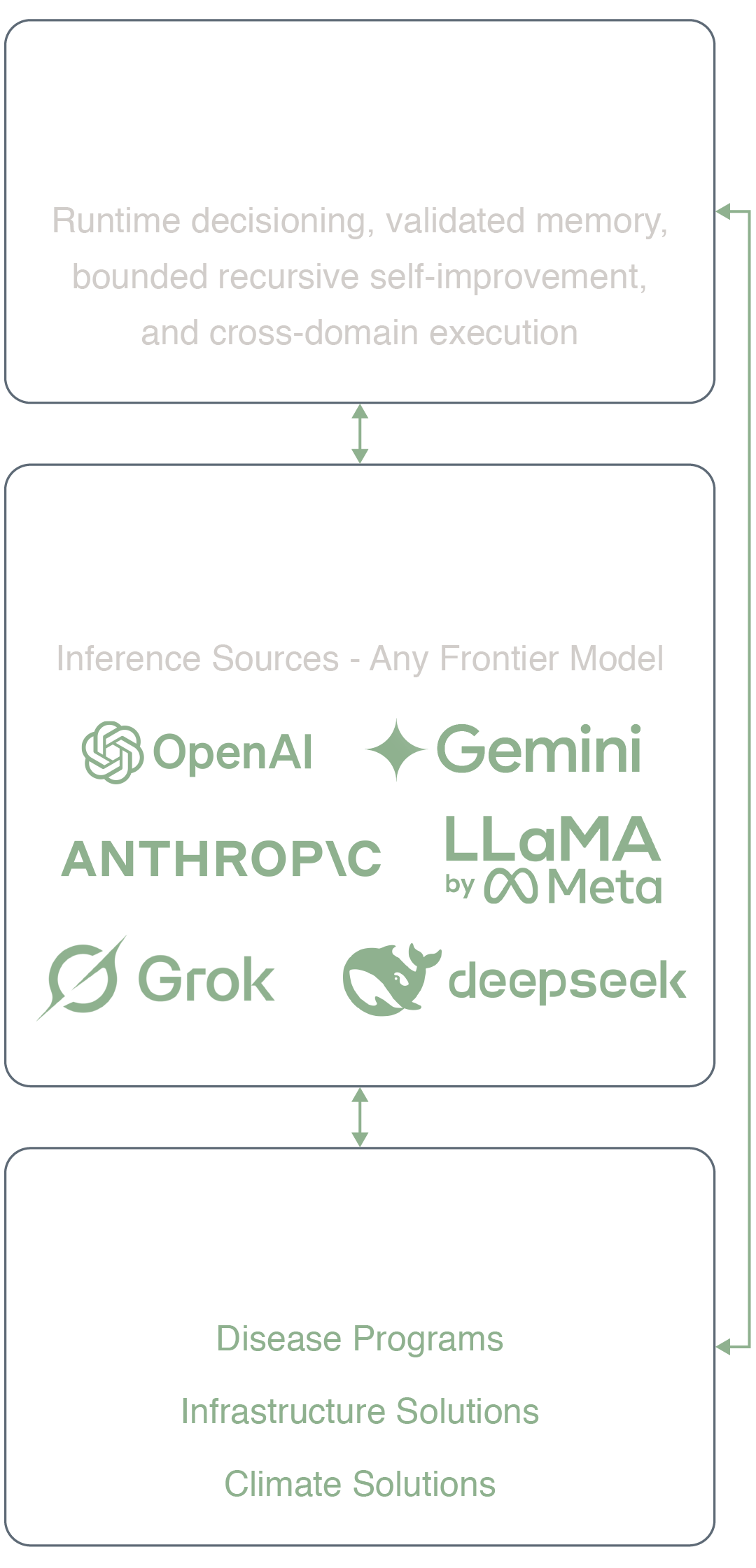
Project 777 turns raw model output into validated, reusable intelligence.
How We Know the System Produces Real Value
Project 777 has both commercial and measured technical validation.
A $1M+ commercial healthcare license for Project 777-generated disease programs.
The system compares its strongest solutions against defined real-world benchmarks and prior baselines, so improvement is measured rather than assumed.
474 solution packages and run records have been produced across more than 1,000 domains.
20,000+ governance-cleared, review-ready outputs have been generated.
Compounding Intelligence in Operation
Intelligence Compounds. Runtime Safety Holds.
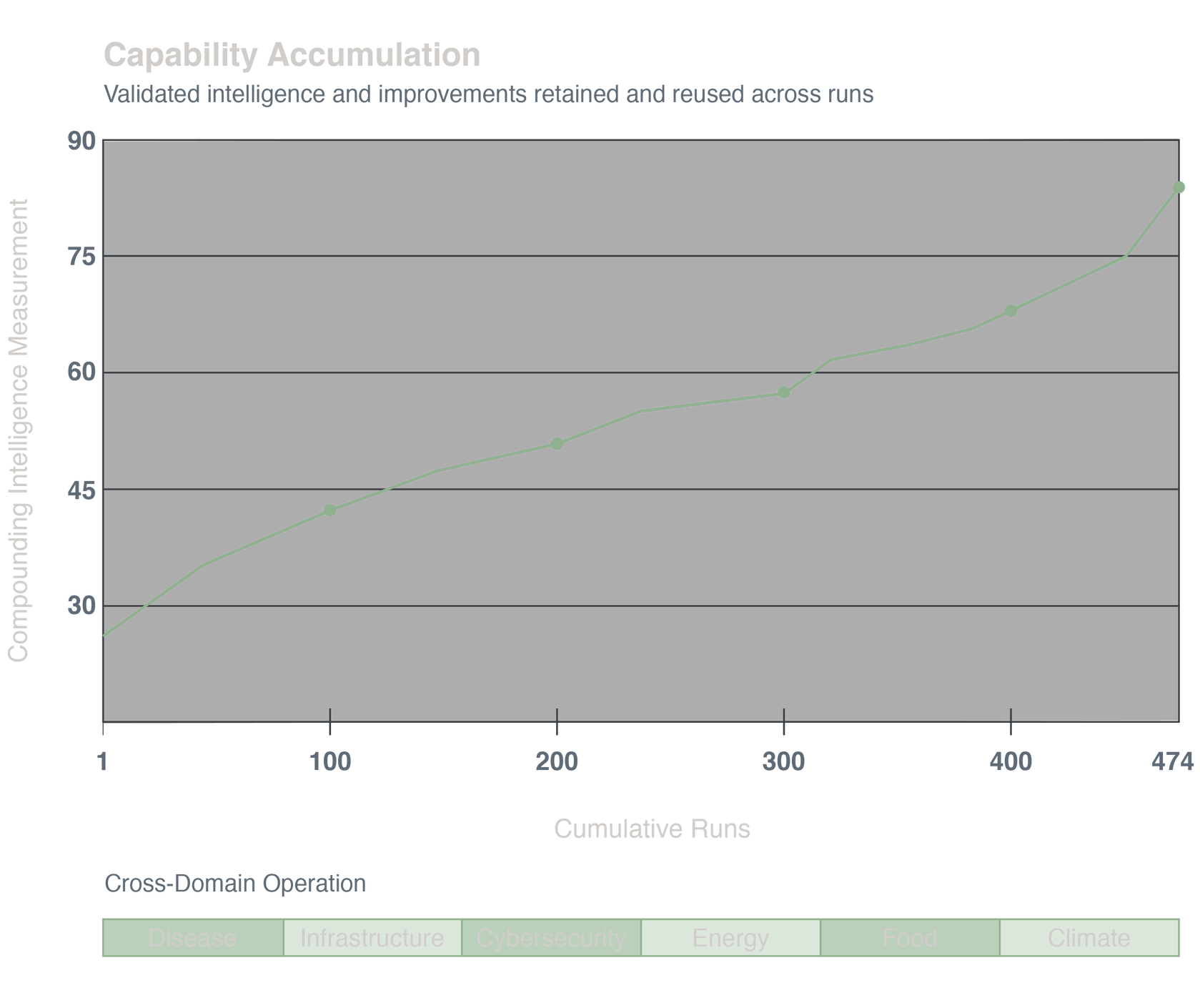
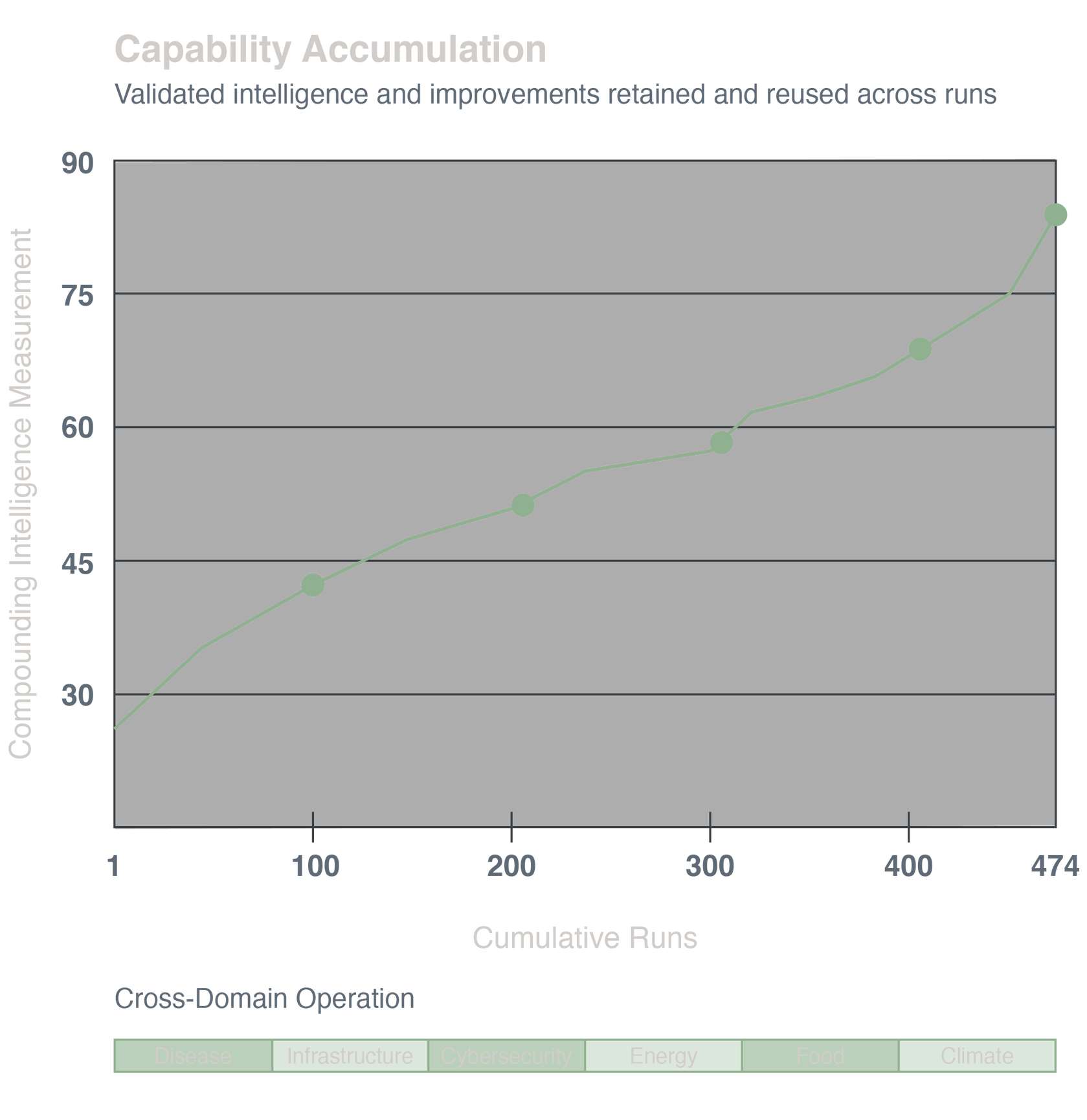
Bounded Recursive Self-Improvement
Validated intelligence and improvements from prior runs carry forward into later runs:
Why this matters now
The market is shifting. Frontier models are increasingly interchangeable. The architectural moat is moving from raw model capability to the infrastructure that can govern, verify, and deploy that intelligence safely at scale.
The next phase of AI will not be defined by the model alone. It will be defined by the architecture that governs intelligence in the real world.
Project 777 is that architecture.
Strategic Conclusion
This is the combination that matters: an architecture that improves within bounds, generalizes across domains, remains governed at runtime, and is independently inspected, verified, and audited.
These results provide evidence of a new class of system: an architecture delivering cross-domain solutions at scale while remaining traceable, auditable, and aligned to human-defined constraints.
Independent Review & Validation
Project 777’s architecture and execution artifacts have undergone independent review across federal technology, regulated AI systems, cloud architecture, cybersecurity, clinical development, and translational medicine. Reviewers include Dr. David Bray (former U.S. Federal CIO), Dr. Roma Shusterman (FDA-regulated medical-device and AI systems executive), Ian Perez Ponce (former AWS technology leader), and Preston Dunlap (former CTO and Chief Architect, U.S. Space Force & Air Force). Additional independent validation includes Rashid Zaman in cybersecurity compliance, Dr. Michael Rosol in clinical development feasibility, Mehmet Tosun, MD, PhD in translational medicine, and Randi Griffin in clinical trial operations.
Founder
TK Stohlman is a former U.S. Army officer and repeat AI founder. He sold his previous AI company in 2021 and has spent the past two years building Project 777, a model-agnostic compounding intelligence layer above LLMs.
Strategic Transition & Integration
Project 777 is currently supporting technical due diligence and architectural reviews for a limited number of frontier labs, hyperscalers, and institutional partners.
Qualified organizations may request a controlled briefing of execution artifacts and system architecture.
Project777.ai
Project 777 © 2026. All rights reserved.